
China Top PVC Profile Mixer Machine Manufacturer?
China has become a major manufacturing base for plastic processing equipment, including the Pvc Profile Mixer. Its competitiveness comes from broad component supply, export experience, and flexible factory production. Yet “top manufacturer” should never mean the lowest quoted price.
Grand View Research’s Polyvinyl Chloride Market Size, Share and Trends Analysis Report identifies construction, pipes, cables, and profiles as important PVC demand areas. The report also describes steady market growth through the decade. PlasticsEurope’s Plastics—the Fast Facts 2024 reports global plastics production at about 414 million tonnes in 2023. These figures show why consistent PVC compounding equipment matters. Small mixing errors can create visible profile streaks, unstable color, or weak corners.
A reliable Pvc Profile Mixer manufacturer should demonstrate more than polished photographs. Buyers should inspect mixing chamber design, rotor material, temperature control, discharge timing, and dust protection. Ask for recorded test results using your actual PVC resin, stabilizer, filler, and pigment. Request batch capacity, power consumption, noise data, and maintenance intervals. Details matter.
Experience matters most here.
A qualified Chinese supplier should provide clear technical drawings, factory videos, spare-parts lists, and documented quality procedures. ISO 9001 certification can support process control, but it does not replace machine testing. CE documentation may support European market access, but buyers should verify its scope and authenticity. No mixer is perfect. Even a strong design may require adjustments for local formulas, climate, or production speed. This guide examines how to compare China’s leading manufacturers with practical evidence, not marketing claims.
What Is a PVC Profile Mixer Machine?
China Top PVC Profile Mixer Machine Manufacturer?
What Is a PVC Profile Mixer Machine?
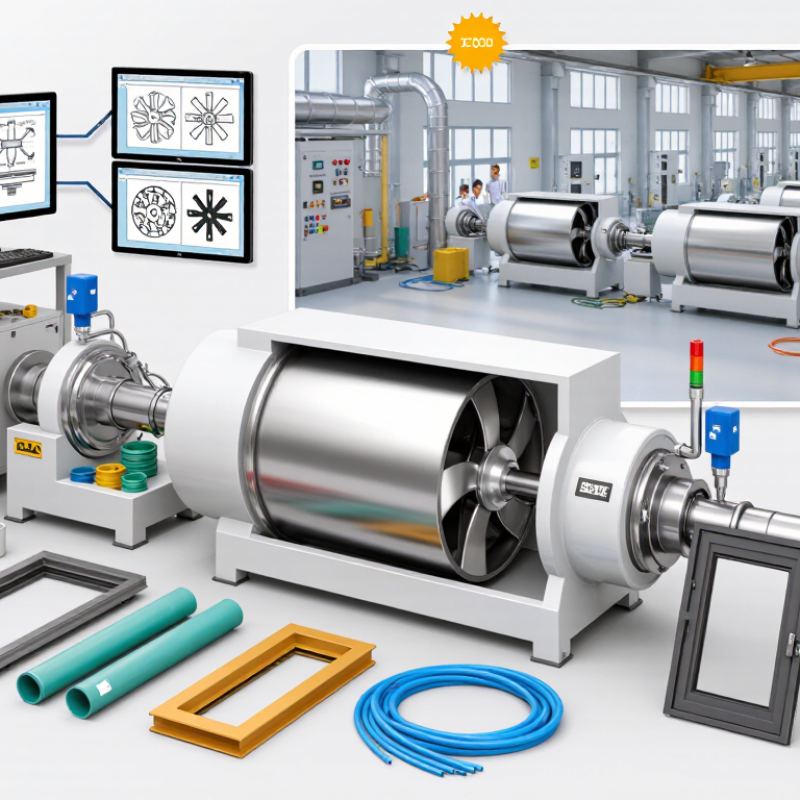
A PVC profile mixer machine prepares a uniform dry blend for extrusion. It combines PVC resin with stabilizers, lubricants, pigments, and impact modifiers. The machine usually has a hot mixer and a cooling mixer. High-speed blades spread additives across each resin particle. The cooling stage then lowers the blend temperature before storage or extrusion.
In practical production, operators inspect the mixer body, blades, discharge valve, and temperature sensor daily. A typical hot-mixing cycle may reach 110°C to 125°C, depending on the formulation. Cooling often continues until the material becomes stable and easy to convey. Mixing time, blade speed, and batch size must match the recipe. More heat does not always mean better dispersion.
A reliable machine should offer strong sealing, steady rotation, and accessible cleaning points. I have seen uneven profiles caused by poor feeding, not only by mixer design. That detail is easy to miss. Residue around the discharge gate can also alter the next batch’s color. Regular checks improve consistency, but no mixer can correct an unbalanced formula. Experienced operators record temperature changes, motor load, and discharge appearance for every batch. Small records often reveal large problems.
China Top PVC Profile Mixer Machine Manufacturer? - What Is a PVC Profile Mixer Machine?
| Category | Data Dimension | Typical Information |
|---|---|---|
| Basic Definition | What Is a PVC Profile Mixer Machine? | A PVC profile mixer machine is industrial equipment used to blend PVC resin with stabilizers, lubricants, impact modifiers, pigments, fillers, and other additives before extrusion into window profiles, door profiles, decorative sections, pipes, and similar products. |
| Main Function | Material Homogenization | The machine distributes powders and additives evenly, helping create a consistent compound with stable color, melt behavior, mechanical performance, and surface quality. |
| Typical Process | Hot Mixing | PVC resin and additives are mixed in a high-speed hot mixer. Friction raises the material temperature, commonly to approximately 110–130°C depending on the formulation and process requirements. |
| Typical Process | Cooling Mixing | The hot mixture is transferred to a cooling mixer, where it is cooled under controlled agitation, commonly to approximately 40–50°C, before storage or extrusion. |
| Machine Configuration | Hot and Cold Mixer Set | A common configuration includes one high-speed hot mixer, one low-speed cooling mixer, a transfer mechanism, a control cabinet, and discharge or conveying equipment. |
| Mixing Technology | High-Speed Mixing | High-speed paddles or blades create intensive circulation and friction. The mixing speed is commonly adjustable, with many industrial systems operating in a range of approximately 500–1,500 revolutions per minute for the hot mixer. |
| Capacity | Nominal Batch Size | Common batch sizes range from approximately 50 to 1,000 liters for profile-compounding applications. Actual output depends on bulk density, formulation, cycle time, filling ratio, and discharge efficiency. |
| Capacity | Approximate Throughput | Typical production capacity may range from approximately 100 to 1,000 kilograms per hour. The final capacity must be calculated from the batch weight and complete hot-mixing, transfer, cooling, and discharge cycle. |
| Power System | Drive Motor | The hot mixer generally uses a higher-power motor than the cooling mixer because it performs intensive blending. Total installed power varies widely according to batch size, commonly from approximately 15 to 160 kilowatts for a complete mixer set. |
| Material Handling | Suitable Ingredients | The system can process PVC resin powder and commonly used dry-blend additives such as thermal stabilizers, lubricants, processing aids, impact modifiers, titanium dioxide, calcium carbonate, and colorants, subject to formulation compatibility. |
| Construction | Mixing Chamber | The mixing chamber is normally fabricated from wear-resistant steel or stainless steel in selected contact areas. The inner surface should be smooth and designed to minimize material buildup and simplify cleaning. |
| Construction | Mixing Blades | Blades are designed to produce axial and radial material circulation. Their geometry, clearance, surface treatment, and wear resistance affect mixing uniformity, energy consumption, and service life. |
| Temperature Control | Temperature Measurement | Temperature sensors monitor the material or chamber temperature. Automatic control can be configured to trigger transfer or discharge when the programmed temperature is reached. |
| Discharge System | Automatic Discharge | A pneumatic or hydraulic discharge valve is commonly used to release the mixed material quickly and reduce residual material inside the chamber. |
| Control System | Operating Controls | A standard control system may include start and stop controls, temperature display, mixing-time settings, speed control, overload protection, emergency stop, and automatic sequence control. |
| Product Quality | Mixing Uniformity | Uniform mixing supports consistent profile color, density, extrusion pressure, surface appearance, and additive distribution. Uniformity should be verified through production trials and laboratory testing rather than by mixer size alone. |
| Application | PVC Profile Production | The mixed dry blend can be supplied to conical twin-screw or parallel twin-screw extrusion lines for manufacturing rigid PVC window profiles, door profiles, skirting profiles, decorative profiles, and technical sections. |
| Application | Other PVC Products | With a suitable formulation and process configuration, the same type of mixing equipment may also be used for certain rigid PVC pipes, boards, panels, cable compounds, and injection-molding materials. |
| Selection Criteria | Formulation Compatibility | Confirm that the machine can process the required resin grade, additive package, filler content, moisture level, bulk density, and target processing temperature without damaging heat-sensitive ingredients. |
| Selection Criteria | Batch and Output Matching | Choose the batch size according to the extrusion line’s hourly consumption. Oversized equipment may reduce mixing efficiency at low fill levels, while undersized equipment may increase cycle frequency and labor requirements. |
| Selection Criteria | Cleaning and Maintenance | Important factors include access to the chamber, ease of blade replacement, sealing design, discharge-valve maintenance, availability of wear parts, and the time required for color or formulation changeover. |
| Safety | Required Protection | A suitable system should include a lid interlock, overload protection, emergency stop, guarded moving parts, electrical protection, and safe access procedures for inspection and cleaning. |
| Installation | Site Requirements | Installation planning should consider floor load, equipment footprint, electrical supply, ventilation, dust control, material feeding, cooling-water or air-cooling requirements, and connection to downstream extrusion equipment. |
| Operating Practice | Recommended Verification | Before continuous production, verify mixing time, temperature profile, batch weight, additive dispersion, discharge residue, energy consumption, and the extrusion performance of the resulting dry blend. |
| Purchasing Guide | Manufacturer Evaluation | When comparing manufacturers, evaluate technical design, documented test results, material compatibility, control-system functions, spare-parts support, installation guidance, warranty terms, and the ability to customize the machine for the required formulation. |